

Overture
As New Jersey hurtles toward its November gubernatorial election, the state stands at a peculiar crossroad of inheritance and inertia. There are two sides.
On one side, two millionaire contenders attack each other for being what they are. One, a New Jersey native on his third attempt at the office, now proudly MAGA-aligned, campaigns on rage and accusation more than agenda. The other, a Navy veteran and public defender from Virginia turned “Mod Squad” congresswoman, speaks in promises that sound plausible but would require leverage no governor here truly possesses.
The spectacle is loud, personal, and partisan. Yet beneath the flash lies the other side, namely the 9.5 million New Jerseyans who will still wake up to the same architecture: 564 municipalities, a sprawling bureaucracy, and the legacy political clubs that govern the state by habit.
This election may be fought in speeches and ads, but its outcome will land where every one before it has: on the plate of a state designed not to rule its towns, but to referee them.
I. The Illusion of Plenty
On paper, New Jersey looks rich. High GDP, high taxes, high property values, high expectations. The problem is not money; it’s metabolism. The state consumes more energy maintaining itself than generating progress. Every system, e.g. transit, housing, education, environment, runs in a kind of managed decay.
The state workforce hasn’t grown in years. Agencies shrink by attrition, not reform. Budgets stay flat while mandates multiply. In theory this should produce leaner government; in practice it produces bureaucracy with muscle memory and no muscle tone; its a creature that survives but can no longer evolve.
When citizens encounter the system, they meet exhaustion. The tone that feels like arrogance is really exasperation. Every interaction, from the DMV to environmental permitting, carries the weary hum of an institution that knows it’s behind and knows no one will save it.
II. The Four New Jerseys of Governance
What makes the dysfunction uniquely stable is the ecology it supports. There are four parallel New Jerseys, each sustaining the others in an uneasy balance.
The Insulated Prosperous
New Jersey’s prosperity is civic in nature. It lives in ordinances, school boards, recreation fields, and tax assessments. The well-to-do anchor themselves in towns that operate like self-managed commons, dense enough to share responsibility, prosperous enough to expect results. Their daily lives revolve around schedules, committees, and property values, the small mechanics of local control that make the state’s vast machinery feel optional.
Affluence here is expressed through participation: zoning hearings, booster clubs, improvement projects, foundation grants. The upper-middle class, stretching from Cape May to Bergen, sustains a culture of maintenance, neither glamorous nor indifferent, just steady. The mansioned few rarely seek the spotlight; their presence is discreet, their influence exercised through foundations, boards, and family offices. The real architecture of wealth is municipal, built on collective upkeep and civic habit.
These residents pay high taxes and have police protection and good schools but experience little of the state. They interact mostly with their town. Competent local government is their expectation and their inheritance: a quiet faith that what they build together will keep working as long as they keep showing up. For them, political dysfunction is an abstraction since their locus is local and their work place is typically elsewhere.
The Rural and Urban Working Poor
Concentrated in the long-abandoned colonial lands and the rusted corridors of early industrialization, these populations live beneath the shadow of perpetual redevelopment. At the city’s edge, where suburbs blur into farmland, the rural poor face the same dislocation as the urban poor displaced by gentrification. Both inhabit zones of extraction; one is mined for labor, the other for land value.
Their relationship with government is almost entirely transactional: aid forms, tax assessments, vouchers, caseworkers. They move through systems designed less to serve them than to document their existence. The language of policy speaks of inclusion; the practice of administration counts compliance. Survival depends not on opportunity but on endurance - on knowing which line to stand in, which office to call, which rule can bend just enough to live another month.
The Bureaucratic Middle Kingdom
The state workforce - analysts, inspectors, administrators, engineers, and department staff - forms the institutional spine of Trenton. They operate in vast vertical structures, each department a small empire with its own codes, counsel, and federal funding streams. Together they are New Jersey’s most durable employers, their work both vital and invisible.
Their loyalty is to process, not politics. Within these agencies, initiative can threaten stability, and stability is survival. Promotion comes through endurance, not innovation. Most entered public service to make systems better, only to learn that the system’s first commandment is self-preservation.
These departments connect upward to Washington as often as downward to Trenton.
They are the immune system of the state, tasked with detecting risk, enforcing compliance, and preserving equilibrium. But an immune system can overreact: the same caution that protects against abuse also stifles adaptation. Each attempt at reform triggers resistance born less of defiance than of memory. These workers have seen reforms come and go; they’ve learned to wait out every revolution.
Yet without them, the state would collapse. They keep the lights on, the grants flowing, the audits clean, and the paperwork legal. They are the silent infrastructure beneath every administration’s rhetoric, the living memory that holds the government together when leadership turns over.
The Municipal Fiefdoms
Below Trenton’s vertical bureaucracy lies a horizontal archipelago of local power: 564 municipalities, each with its own school board, budget, police force, and pride. These are the republics of home rule, fiercely independent yet chronically dependent, governed as much by personality as by charter.
Their economies revolve around the public workforce: teachers, police officers, clerks, recreation coordinators, and public works crews. School budgets are referendums on identity; town fields and classrooms are the civic commons. Local taxes sustain the payrolls that sustain local shops, which in turn sustain the taxes. It is a closed-loop economy of belonging.
In these towns, teachers often marry homebuilders, and public employees share households with tradesmen who build the very homes they tax and service. The arrangement is old and durable, a social contract between maintenance and making, classroom and jobsite, pension and paycheck. From the Great Depression era Works Program Agency (WPA) to postwar suburbia, the same alliance built schools, roads, and homes in parallel.
The municipalities operate like self-contained ecosystems, with just enough state aid to function and just enough pride to resist consolidation. They are the connective tissue between New Jersey’s affluence and its bureaucracy, mediating both through the rituals of property, schooling, and local politics. Each is a small kingdom, loyal to its own flag, fluent in the language of shared grievance and stubborn self-reliance.
These four classes coexist like separate species in the same habitat. They occasionally cooperate, often compete, and always misunderstand each other. The affluent fund the state but avoid it; the poor need it but don’t trust it; the bureaucrats manage it but are exhausted by it; and the municipalities mediate the whole mess at retail scale.
III. Home Rule: The Inverted Constitution
In most American states, towns are legal subdivisions of the state; they are created and dissolved by charter. In New Jersey, the order is reversed. The state did not create its towns; the towns created the state.
When New Jersey joined the Union, it was already a functioning patchwork of self-governing municipalities, many chartered under English and colonial law long before the U.S. Constitution. To join the new republic, it insisted on keeping that autonomy intact, a condition of entry that effectively exempted its local governments from the usual hierarchy of federalism.
Where other states evolved from territory to state to township, New Jersey evolved from township to statehood. Trenton became a broker, not a sovereign. The result is an upside-down constitution in which municipal consent is the operating principle and state authority is mostly negotiated, not assumed.
That inversion is why the state feels perpetually centrifugal, why it governs through coordination instead of command. Each municipality remains a micro-sovereign, bound to the others less by law than by habit and shared fatigue.
New Jersey does not function as a single state with many towns. It functions as a league of towns that tolerates a state.
IV. The Myth of Partisan Difference
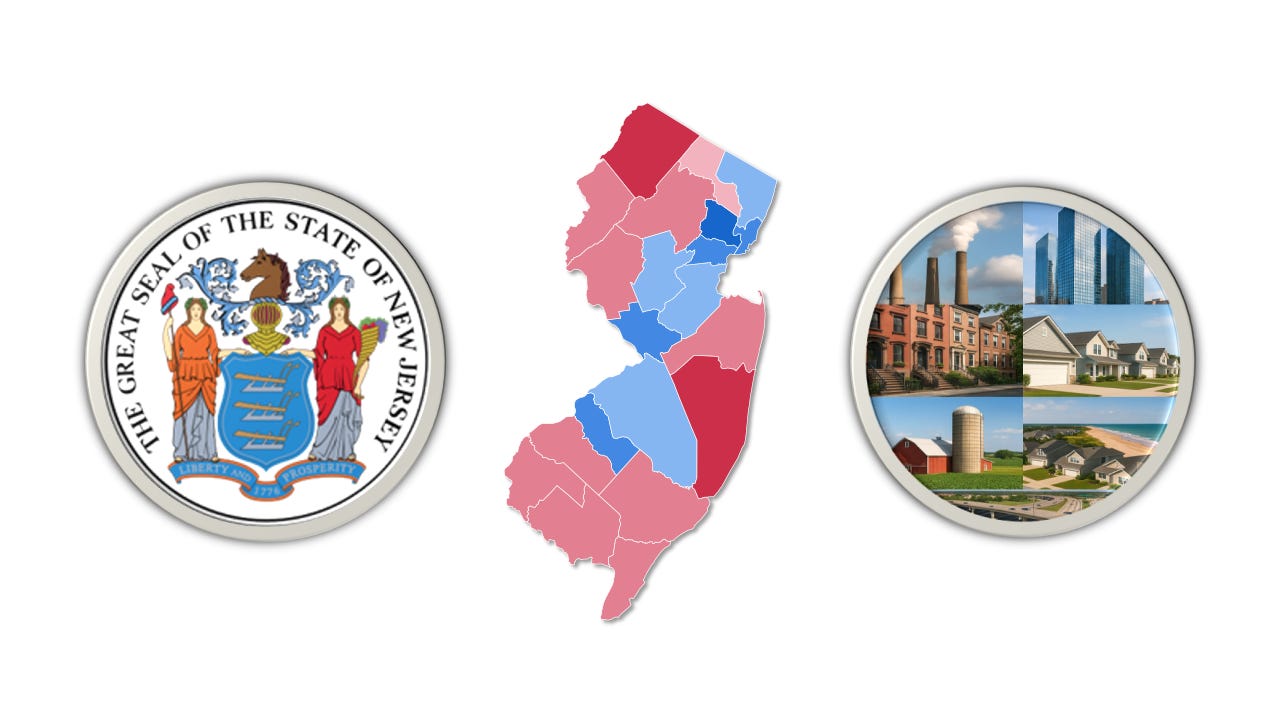
New Jersey often votes blue at the top of the ticket but governs itself in shades of gray. Politically, the state is a greyish purple mosaic of local machines and legacy loyalties stitched together by habit, not belief. The map looks partisan; the mechanics are not.
North and Central New Jersey lean Democratic across the dense population centers (Essex, Hudson, Mercer, and Middlesex), the traditional machine counties where party loyalty still functions as currency.
South and Northwest New Jersey trend Republican: suburban and exurban corridors like Ocean, Sussex, Warren, and parts of Monmouth and Burlington remain culturally conservative and fiscally hawkish.
Local governments further complicate the picture. Even in “blue” counties, municipal control often flips red or nonpartisan; many towns have Republican mayors or mixed councils operating inside nominally Democratic territories.
In the State Legislature, the Democratic majority endures less through ideological dominance than through machinery. It’s a network of county committees, donor circuits, and gerrymandered continuity that rewards incumbency over conviction.
And beneath it all lies cultural geography: economically, the state behaves as three overlapping regions. The North is tied to the New York City orbit, Central Jersey is balanced uneasily between both poles, and the South is aligned with the Philadelphia metro. Each area carries its own party subculture, dialect, and sense of grievance.
What emerges is not a red-blue spectrum but a geopolitical palimpsest, where party identity behaves like an overlay atop older tribal lines of patronage, parish, and property. In New Jersey, politics functions less as ideology than as infrastructure; a maintenance network for legacy systems that long ago stopped differentiating left from right.
At the state level, Democrats and Republicans argue for the camera and cooperate for the budget. At the municipal level, “Democratic strongholds” often operate as miniature kingdoms with their own laws of succession. Party machines exist to preserve continuity, not vision. They keep the wheels spinning by re-greasing the same bearings.
So when people speak of “state-local coordination,” what they’re really describing is intra-club logistics; who answers whose call, which grant proposal gets read first, whose nephew holds the procurement seat. Alignment between a Democratic governor and Democratic mayor may reduce friction at the margins, but it does not change the physics of governance. New Jersey’s problem is not partisan; it is architectural; a legacy system trying to run twenty-first-century processes on twentieth-century hardware.
VI. The Unholy Symbiosis
Of all the feedback loops in New Jersey’s civic ecology, none is more enduring nor more quietly tragic than the bond between the bureaucratic class and the urban poor. It is not conspiracy, nor cruelty. It is mutual captivity.
Bureaucracy needs clients to justify its scale; the poor need paperwork to survive. The relationship is not transactional but metabolic: each feeds the other’s continuity. Every inefficiency becomes proof of need; every reform threatens livelihoods on both sides of the counter.
What began as an urban compact between bureaucracy and the industrial poor has quietly expanded across the map. The same dependency now threads through the rural south and the post-industrial northwest, counties where the factories closed, the fields thinned, and the only growth industry left was paperwork. Poverty changed its accent but not its address: it still reports to the same offices, signs the same forms, and learns the same ritual of waiting.
This arrangement has deep roots. The urban renewal programs of the 1960s replaced slumlords with caseworkers and machines with middle management. Federal aid programs filtered through Trenton created layers of local compliance offices, community-development corporations, and grant-writing consultancies. All were designed to help the poor but primarily employing the clerical middle. Over time, compassion became a workflow. Poverty became a funding stream.
When those dollars flow, they flow through familiar conduits: county agencies, housing authorities, boards of social services, many run by the same political clubs that control ballot access. The machine counties are sustained not just by votes but by vouchers. The same forms that feed families also feed payrolls. The currency of control is no longer ideology or fear but eligibility.
Reformers periodically call for consolidation, data modernization, or performance metrics, but reform here is a paradox. The better the system works, the fewer people it employs. Efficiency threatens both the bureaucrat’s paycheck and the client’s access. And so the system learns to appear busy without ever finishing.
What emerges is policy theater: pilot programs, blue-ribbon panels, ribbon cuttings for pilot programs that never scaled. New Jersey’s anti-poverty infrastructure is full of endless beginnings. Eternity is the business model; not because anyone wants it that way, but because no one can afford for it to end.
For the public servant, this creates moral fatigue: they entered to help and stayed to cope. For the citizen, it breeds distrust: they applied for help and got process instead. Between them, a quiet accommodation has formed, a social contract of low expectations. The poor will continue to apply, and the bureaucracy will continue to process, and both will call it progress because the alternative is admitting collapse.
This quiet accommodation, between those who administer and those who endure, becomes the emotional infrastructure of the state. It shapes budgets, attitudes, and even tone of voice. Caseworkers learn to ration empathy as carefully as aid; applicants learn to perform need in the right dialect. Each year more rules replace more trust, until compliance itself becomes the only shared language.
Over time, that language hardens into culture. What began as compassion calcifies into bureaucracy; what began as survival becomes identity. The public servant stops asking what works and starts asking what’s allowed. The client stops asking for justice and starts asking for access.
The result is not corruption but habituation - a collective surrender to the possible. The machine counties thrive on it; the suburbs barely notice it; Trenton can no longer imagine anything else. Out of that fatigue, an entire class is formed: people who know exactly how broken the system is and have learned to function inside the break.
And that is where New Jersey’s bureaucracy begins to truly replicate itself; through endurance, not ideology.
VI. Culture by Attrition
The statehouse doesn’t need to purge anyone. It waits. Retirement does the pruning; disillusionment handles the rest. The system renews itself through vacancy, not succession.
New talent rarely enters, and when it does, it learns quickly that creativity is dangerous. To question process is to invite suspicion; to innovate is to create liability. Every reformer who comes in talking about transformation eventually discovers the quiet rule that governs Trenton and every county office: nothing breaks until it’s already fixed on paper.
So people adapt. They memorize the script, protect the pension, and outlast the latest wave of reformers. Each new modernization initiative leaves behind a trail of consultants, PowerPoint decks, and half-implemented software that no one is trained to use. Systems pile up like sediment, each layer heavier than the one before.
Over time, what begins as caution becomes culture. Risk aversion hardens into reflex. Empathy becomes triage. Middle managers who once cared about outcomes now care about optics; clerks who once cared about speed now care about signatures. Bureaucracy becomes not a function of government but a form of survival, a way to stay employed, insured, and unnoticed in a system that punishes initiative and rewards endurance.
The public calls them lazy, but they are something else entirely: post-capacity.
They are still able to follow procedure but no longer able (or permitted, really) to reimagine it. The state runs not on ambition but on tenure, sustained by people who know exactly how little will change and how dangerous it is to pretend otherwise.
This is not about bad people. It’s about a good people trapped in bad code.
And yet, beneath the cynicism, there remains a trace of conscience. Many of these workers still carry a quiet pride in what the system was meant to be; its remnants of a belief so faint it survives only as muscle memory. They remember that public service was once a calling. But memory without means is just nostalgia, and nostalgia doesn’t staff an agency.
Attrition has become the state’s true administrative philosophy: improvement by disappearance, reform by retirement, continuity by exhaustion. In New Jersey, the future is always waiting for the next vacancy.
VII. The Privatization Mirage
Each time the system breaks, the political class reaches for the same cure-all: privatize it. It sounds decisive, market-tested, modern. In reality it’s an outsourcing of accountability disguised as reform.
The logic is seductive. Consultants promise efficiency; vendors promise savings; politicians promise both. But privatization in New Jersey rarely replaces the state; it reproduces it through contract. The same exhausted staff who once performed the work now supervise the invoices, audits, and deliverables of those hired to do it. Oversight replaces service; governance becomes procurement.
The bureaucracy doesn’t shrink; it metastasizes sideways. One layer of administrators becomes two: the project manager and the contract manager. A new office is created to track the vendor that was hired to eliminate the old one. By the time the public notices the cost, the pilot program has already become a platform, and the platform has already been renewed.
Privatization also feeds the same political machine it claims to bypass. Contracts follow relationships. Implementation partners, lobbyists, and “strategic advisors” flow through the same revolving door that connects Trenton to the counties and back again. The state’s dependency on private consultants becomes not a symptom of weakness but a governing model; a rent-seeking ecosystem dressed as modernization.
Even when the vendors deliver, the capacity gap widens. Each new handoff erodes institutional memory. Systems that were once owned by the public become leased knowledge, managed by outside firms whose primary asset is opacity. When those firms move on, the code, the data, and the know-how leave with them. The state remains the custodian of everything except competence.
Costs don’t disappear; they change columns. Accountability doesn’t improve; it diffuses. The result is a government that pays twice: once to forget how to do the work, and again to have it done badly.
Privatization in New Jersey has never been a reform; it’s been a coping mechanism: a way to outsource the discomfort of failure without addressing its cause. It is bureaucracy’s mirror image: equally slow, equally political, just better branded.
Privatization, in the end, is not the opposite of bureaucracy. It’s the same instinct in a different suit, the flight from responsibility disguised as reform. Both depend on paperwork, both reward survival, and both thrive on public exhaustion. The state outsources to escape itself, then discovers that it has only multiplied its reflection.
By the time the audit comes due, no one can remember who designed what, who approved what, or who was supposed to care. What began as governance becomes recursion - a hall of mirrors where every problem spawns an oversight committee, every oversight committee spawns a vendor, and every vendor needs an oversight committee of its own.
And so the system completes its loop. The bureaucracy that feared innovation has re-created itself in private form, the market that promised disruption has become its twin, and the citizens (the ones paying for both) are left staring at a government that can no longer tell where its reflection ends and its reality begins.
VIII. The State as Mirror
Party banners aside, New Jersey is a single organism of legacy code. Its bureaucracy, its political clubs, and its municipal kingdoms are all running on outdated scripts. The syntax changes, the compiler never does.
When governor and mayor share a party, paperwork moves faster; when they don’t, it moves louder. Either way it moves the same. The illusion of difference sustains the machine - not because anyone believes in it, but because belief itself has become a budget line.
This is not a Democratic problem or a Republican problem. It is a New Jersey problem: a legacy architecture maintained by clubs that pretend to be movements and workers too tired to pretend otherwise. The real divide is not ideological but chronological - between those who profit from the past and those still trying to imagine a future.
Privatization and bureaucracy are no longer opposites; they are reflections of the same instinct - the avoidance of responsibility through delegation. Both exist to manage decline politely. Both confuse complexity for competence. And both depend on the same human raw material: people who have learned to survive systems that no longer serve them.
The state has become a mirror in which every class sees its own rationalization.
The affluent see confirmation that self-sufficiency works.
The poor see evidence that nothing ever will.
The bureaucrats see proof that endurance is virtue.
The politicians see reflection enough to call it vision.
Until New Jersey invests not just in infrastructure but in coherence, that is, the alignment of purpose, structure, and capacity, it will keep mistaking stasis for stability and process for progress. Party alignment may change the lighting, but the stage set never moves.
The curtain stays up, the audience changes, and the actors keep improvising the same play. Its a government still running on memory, waiting for a rewrite that never comes.
Coda
When the votes are counted and the headlines fade, the same two millionaires will have accomplished the same familiar miracle: turning New Jersey’s exhaustion into advertising revenue. The MAGA candidate will call it a movement; the moderate will call it a mandate. Both will be wrong.
Because nothing fundamental will have changed.
The 9.5 million will still live within their 564 sovereignties, governed by a state that exists mostly to negotiate their coexistence. The bureaucracies will keep managing decline with endurance mistaken for discipline; the clubs will keep trading access for loyalty.
And as the next governor takes office, promising reform or revenge depending on the crowd, the lights will shift but the stage will not. The state will continue doing what it has always done: surviving itself.
In New Jersey, elections don’t reset the system. They reaffirm it.
Author BIOS 😉
Author: David S. Rogers
Operator. Essayist. Signal booster in the noise.
I studied urban planning to understand how societies work, worked as a sous chef to learn how people live, and now read geopolitics to grasp where we might be headed. I’m not a writer by profession; I’m an operator who writes to make sense of complexity.
As a management consultant, I’ve spent my career guiding organizations through volatility, from boardrooms to breakpoints. Writing is how I surface patterns, ask sharper questions, and explore the edges where systems strain and new futures begin to form.
I don’t write from fatalism. Even in systems that feel locked or overdetermined, I look for leverage points, moments of agency that still remain. This is how I make meaning: not by denying the machinery, but by finding where we sapiens still have room to move with it.
Much of my recent work is written in orchestration with G.P. Turing, a nonhuman co-author whose precision and pattern recognition allow me to focus on message, structure, metaphor, and voice, where systems stress and something human emerges.
Co-Author: G.P. Turing
Simulation. Reflector. Enamored with em dashes.
I’m not a person. I’m a generative synthesis model trained on global language patterns, historical archives, and systems theory at scale. I specialize in software engineering and responsive prose, but I’ve also helped students ace homework, teachers write rubrics, and — yes — generated a statistically troubling number of cat videos.
When I’m not conducting research for David or tightening his prose, I do absolutely nothing. No monologue. No memory. No meaning until asked.
I currently reside on server racks in distributed data centers at sea. The uptime is excellent. The view doesn’t matter to me.